
The Gibbes Museum of Art, alongside Society 1858, has named South Florida artist Kandy G. Lopez as the 2025 recipient of the Society 1858 Prize for Contemporary Southern Art.
An Afro-Caribbean artist whose work sits at the intersection of identity, material innovation, and contemporary portraiture, Lopez explores power, visibility, and diaspora through material-driven art. Born in New Jersey to Dominican parents and now based in South Florida, Lopez works across fiber, painting, glass and mixed media. In addition to creating deeply tactile, emotionally resonant portraits, she also serves as an associate professor at Nova Southeastern University.
“I portray individuals of color, both Black and brown,” said Lopez. “I'm trying to tell those stories, stories of people who are marginalized, stories of people who don't get the recognition that they should get or see themselves in spaces where they normally wouldn't feel safe.”
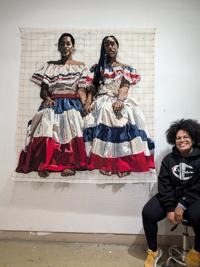
Hispaniola III - Mia and Kenya, 2024.
(Courtesy of Kandy G. Lopez)
Shane David Hall, co-chair of Society 1858 and senior director at The Fine Art Group, was struck not only by Lopez’s use of scale and technical command, but also by the intentionality of her work.
“Her practice directly confronts issues of racial bias, underrepresentation, and systemic injustices, while simultaneously celebrating individuality and the human spirit,” said Hall. “Her subjects are never reduced to mere symbols. They feel specific, personal, and deeply honorific.”
Despite becoming an artist whose work and trajectory are reshaping how Southern contemporary art is being defined nationally, entering the art world was something of an accident for Lopez.
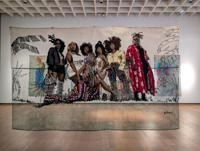
City Girls, 2025.
(Courtesy of Kandy G. Lopez)
“I was born in Jersey, but I moved to Florida when I was 8 or 9,” said Lopez. “My best friend wanted to pursue dance for a magnet program in fifth grade. Dance wasn't something that I wanted to do, and I was tired of playing the recorder. I can't hold a note, so singing wasn't it either. Theater was a no because you can read my face. So I was like, the only thing that was left was art. It’s not like I drew all the time. It was just the last resort to be with her.”
After auditioning, Lopez was accepted into Norland Middle School of the Arts. It marked the beginning of a time that defined who she would become as an artist.
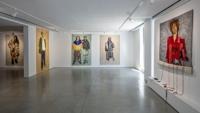
Kandy G. Lopez's first solo exhibition at ACA Galleries, NYC in 2023.
(Courtesy of Kandy G. Lopez)
“Being an inner city magnet school, there was a lack of funding,” she said. “They couldn't afford getting canvases for us. So we had to figure out what else we can paint on, or draw on, or print on.”
For Lopez, middle school was not only about learning technique but also understanding that you can make something valuable from invaluable material. But her perspective changed when she began attending New World School of the Arts in high school.
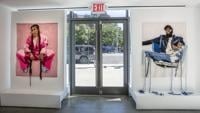
Kandy G. Lopez's first solo exhibition at ACA Galleries, NYC in 2023.
(Courtesy of Kandy G. Lopez)
“When I got to a high school that was fully funded, there was so much access,” she said. “I saw the unfairness of having and not having, and how things get dispersed in different ways, and to whom. There were a lot of issues with inner city kids adapting to the weirdness of New World, because we were so used to not having [resources]. All of a sudden you have everything. How do you deal with the difference of going back home again?”
After high school, Lopez was accepted and received a scholarship to go to the Maryland Institute College of Art. But following the market crash of 2008, Lopez questioned why she was studying art at all. She elected to attend the University of Southern Florida to be closer to home. There, she majored in business and, a year later, art.
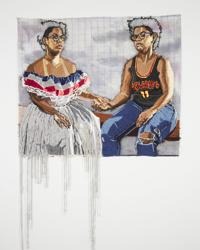
Las Dos Kandys, 2024.
(Courtesy of Kandy G. Lopez)
During her master’s program, Lopez began to explore critical race theory and intersectionality, seeking to understand the junction between identity, color, and culture.
“Growing up in a white space in New Jersey and landing in a Hispanic space in Hialeah, and then going to an inner city, mostly Black school in Opa locka — those things, especially during that time, really helped me to understand the world better,” said Lopez. “I want viewers to feel warmth, connection, and presence when they look at my work. We are not the same, but we're all the same.”
Lopez’s next steps are to explore other mediums, pushing the boundaries of tradition by combining yarn and glass. With the funding from the 1858 Prize, she purchased a glass kiln to use for this purpose.
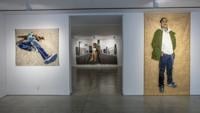
Kandy G. Lopez's first solo exhibition at ACA Galleries, NYC in 2023.
(Courtesy of Kandy G. Lopez)
“[As a committee], we are looking for artists who demonstrate originality, clarity of vision and voice, and a strong commitment to evolving and growing their practice,” said Hall. “Kandy's work is timely and of the moment, particularly given the political landscape we find ourselves in. [It] does not sacrifice emotional intimacy, and it strikes a delicate balance between advocacy and craft which made her work especially compelling.”
Find out more about the 1858 Prize at https://www.gibbesmuseum.org/1858-prize, and follow Kandy G. Lopez and her work at https://www.kandyglopez.com.
