
“For me, they’re still paintings,” she says. “I’m just using yarn to paint. I’m viewing it in a way that a painter would view it.” Her palette: an assortment of craft store yarn; her canvas: hooking mesh; her brushstrokes: a self-taught, dynamic weaving method.
It’s a technique the Dominican American artist created by accident when a piece of string fell on one of her collages of a streetscape, serendipitously landing on an image of a power line. Lopez, 38, was intrigued not only by the string’s appearance on the artwork, but by what fiber could imbue on the piece.
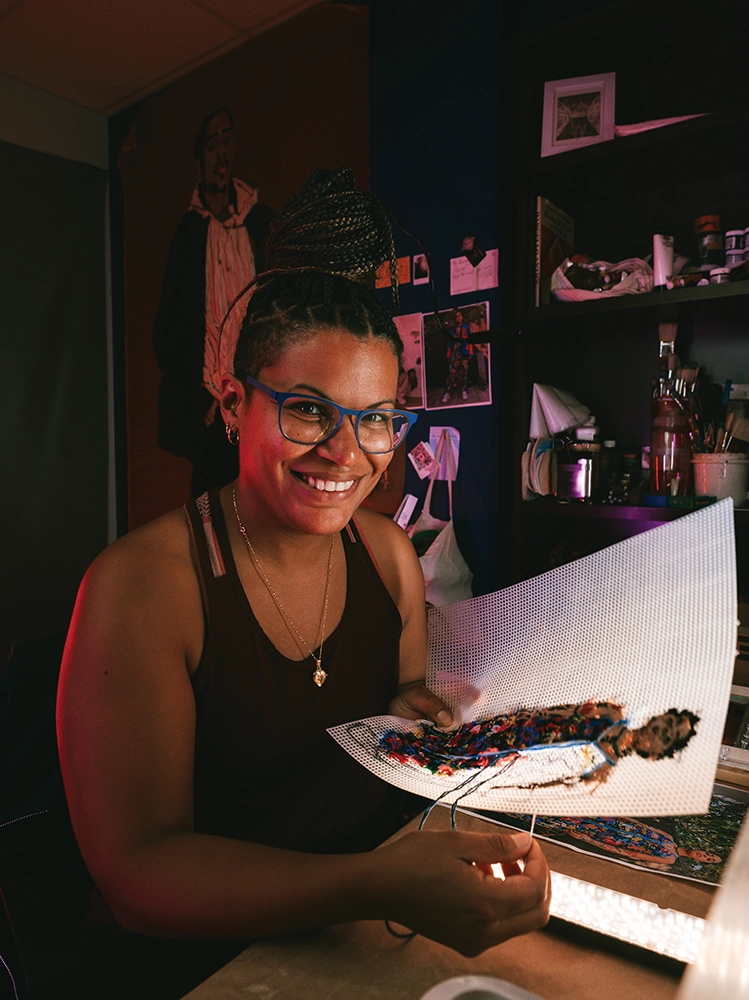
In the wake of Trayvon Martin’s killing, she was inspired to make a political piece—a rug portrait of her then-boyfriend and now-husband, who, like Martin, was a Black male living in Florida. “Then nobody wanted to step on it,” she says. “That’s something in itself, right? There’s a lot of things that happen inside of the mind for you to understand that you don’t touch art or step on art, or that it’s valuable in comparison to people in general.”
Lopez’s use of yarn expanded beyond power lines, but she continued to depict Floridians in her work who have been historically underrepresented in American galleries. Lopez’s work adorns museums and gallery spaces across the country—from New York and California to South Carolina and her home state of Florida. They’re often of Afro-Caribbean Floridians like herself, whose forms emerge on canvas from hundreds of overlapping strings. Experiencing her work is like looking at a ’90s Magic Eye, where the threads reveal themselves from the image as you train your eyes to focus.
Creating these portraits is a time-intensive process that begins with finding a model. Sometimes it’s someone she knows, or sometimes a Miami pedestrian catches her eye. This was the case with LoriAnn, a woman clad in a vibrant bandana-patterned ensemble that Lopez spotted at Art Basel.
There’s a lot of things that happen inside of the mind for you to understand that you don’t touch art or step on art, or that it’s valuable in comparison to people in general.
—Kandy G Lopez
“There was this lady, and she was wearing this outfit. She had this huge ‘fro and her shoes were cool, and the outfit was cool,” Lopez says. “I asked for her permission to create a piece, and she said, ‘Do whatever it is you need to do.’”
So Lopez took a photo of her and hit the studio. Using her typical approach, Lopez began by mapping out LoriAnn’s shape with an Expo marker onto a mesh canvas. She then punctured the canvas with black thread to create the iris before adding color, beginning a 35-hour weaving marathon.
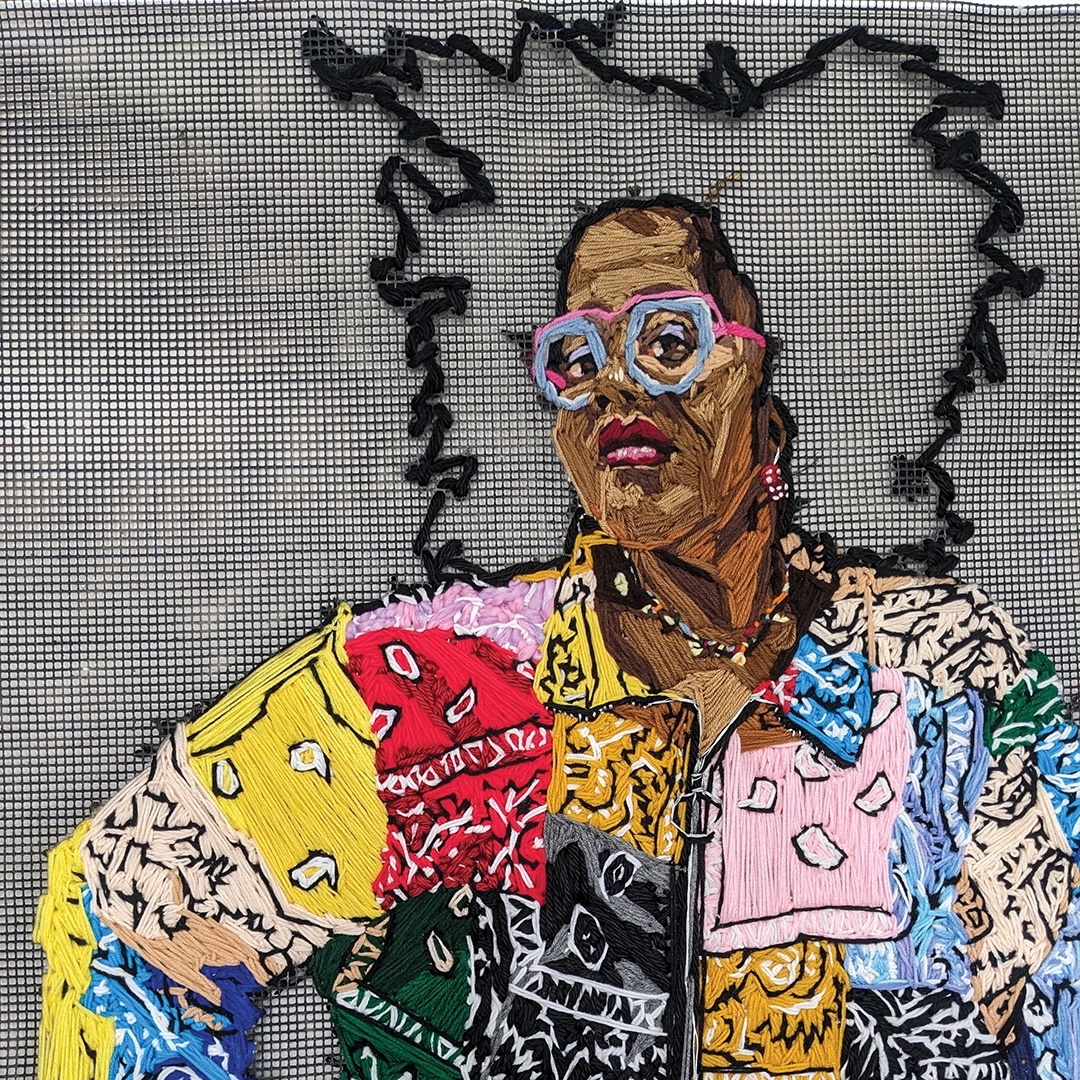
The resulting piece, “LoriAnn,” stands at 8 feet tall, confronting the viewer in her arresting outfit—what Lopez calls armor. “A lot of my paintings also deal with the clothing that we wear and how we present ourselves in different spaces … it’s a defense mechanism so that people don’t mess with you, especially in the city. There’s this really hard stare and glare that you have to put on, especially as women, inside of these spaces.”
But nearly as important as the woven parts of her pieces are the spaces she leaves empty in her works, like LoriAnn’s hair. “They’re still growing, so the negative space still reads as an incomplete person,” she says. “When it comes to hair, I want the emphasis to be on what’s not there, because it starts these conversations. Hair is such an important part in Caribbean culture, Black culture and this idea of good versus bad. It’s important for me to get people to start thinking about why.”
Lopez has excelled in many styles over the years—stained glass, collage and, now fiber. But ultimately, no matter the subject or style, her favorite artistic medium is experimentation. It’s a skill born from her time growing up in art schools in Miami. “I think that was ingrained with us in middle school, because we didn’t have much, so we had to figure out how to share and paint on cardboard and do cyanotypes to get us technically understanding what was happening within the pieces.”
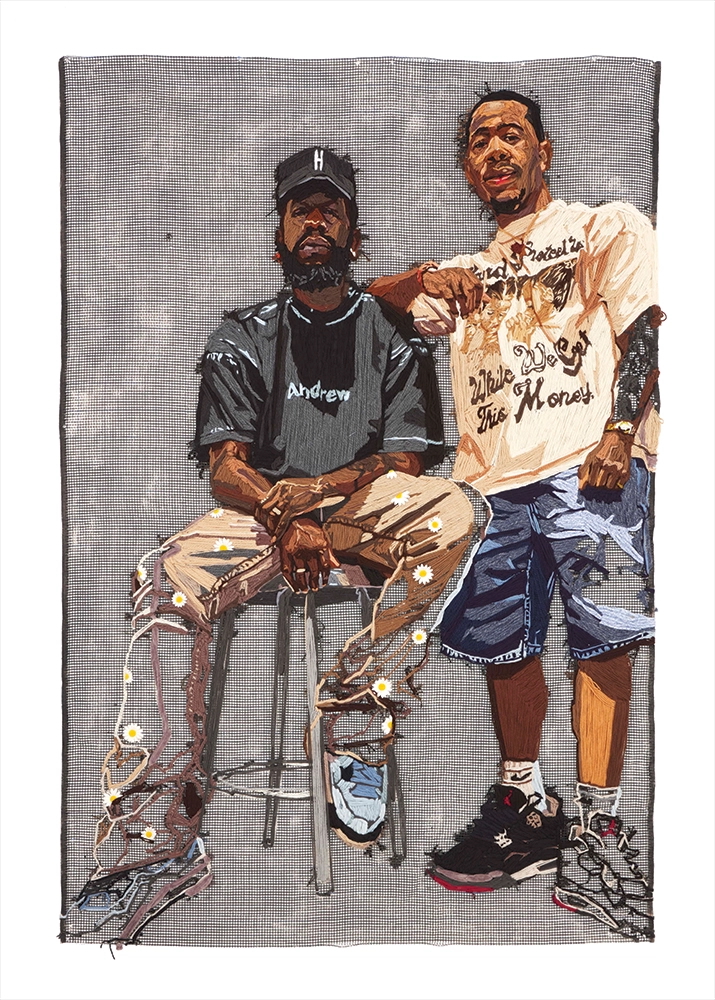
Even now—although she loves fiber paintings—she’ll never close herself off to the ebbs and flows of experimentation. “When I get tired of doing this, I’ll do stained glass, and when I get tired of doing stained glass, I’ll make a ceramic piece,” she says. “I like to just play a lot with a lot of different things.”
No matter the artistic medium, she won’t stop representing the people she loves in her art—from pieces that make the viewer reflect on systemic injustice to those that invite a gallery-goer to a celebration of Florida’s Afro-Caribbean community. “I just want people to see themselves and to feel comfortable being in that space,” she says. “I hope they can see a friend, themselves, an uncle, a sister, a cousin. I just want it to feel warm—like family is in the room and that they’re invited to the space.”
